

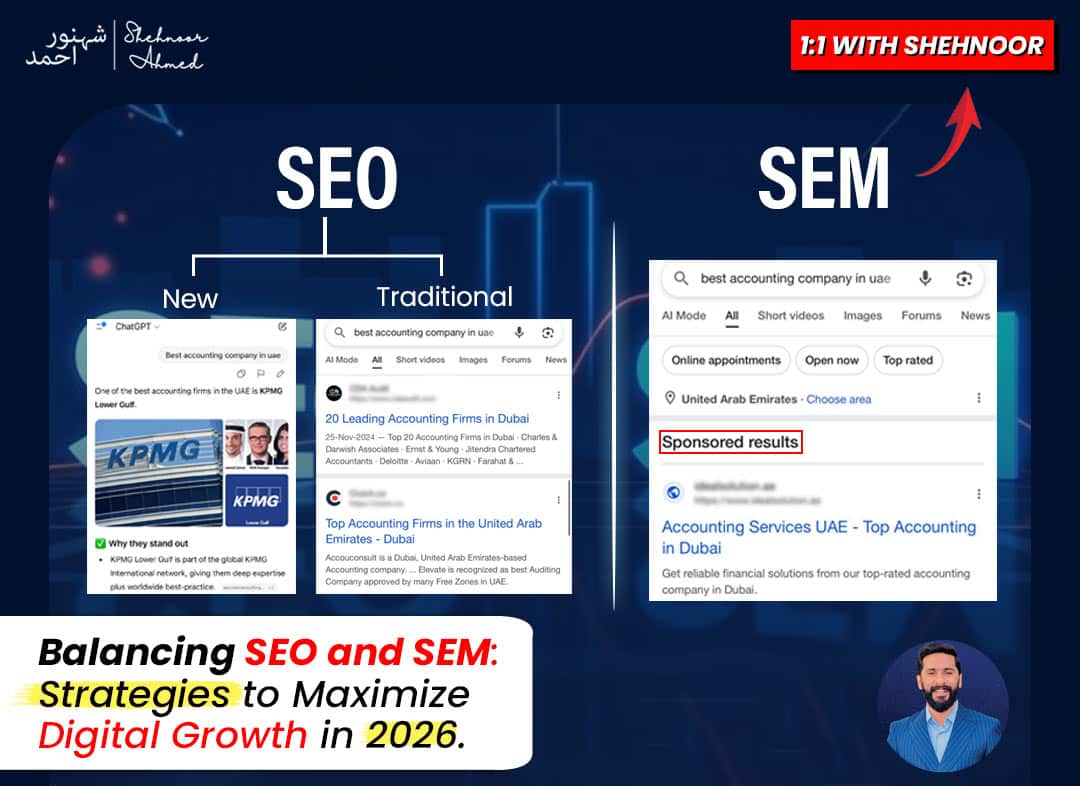
Most business owners treat SEO and SEM like they’re rivals. They pick a side: “I’ll go organic” or “I’ll go paid.” That’s a major missed opportunity.
Because when you combine them, you build something far stronger than either one alone. One gives you durability, the other gives you speed. Together, they cover the short-term and the long-term.
Getting Clear on What Each Does
- SEO (search engine optimization): You earn your spot in Google organically. You fix your site, publish useful content, and build trust over time. No one pays per click.
- SEM (search engine marketing / paid search): You show up at the top immediately via ads. You bid on search terms, create compelling ads, and pay for each click. You get visibility fast, but it costs each time.
These two work completely differently in terms of timeline and cost:
- SEO = slow build, no cost per click (once you’re ranked).
- SEM = instant visibility, but you’re paying for every click.
One isn’t “better” than the other; they just serve different purposes.

The Power of Combining Forces
Imagine you’re launching a new service.
If you only go SEO, you wait 3-6 months (or more) for meaningful traffic.
If you only do ads, you get traffic now, but your cost stays high, and once you stop paying, you vanish.
Smart move? Do both:
- Launch paid ads now to bring in customers quickly.
- Simultaneously, build your organic foundation so you reduce dependence on ads later.
- Because when someone sees your brand both as an ad and in organic results, they assume you’re credible. That extra brand signal drives more clicks.
Research backs this up: for many e-commerce firms, combining SEO + SEM drives better brand visibility. ResearchGate
Researching What Matters to Searchers
Here’s a mistake: business owners are guessing what terms people search for instead of checking.
Tools exist. Use them.
- Find the specific phrases people use. Yes, “marketing help” is ok, but “B2B SaaS marketing consultant Chicago” is way better if that’s your niche.
- Use competitive terms in paid ads (where you can buy visibility).
- Use medium/niche terms for organic content (where you can rank over time).
The goal: match what people are actually searching for, not what you think they search.

Creating Genuinely Useful Material
Search engines are smarter now. They don’t reward fluff. They reward usefulness.
- Write content your audience needs. What keeps them up at night? What questions do they ask?
- Use clear language. Short paragraphs. Real examples. Skip corporate-speak.
- Here’s a tip: look at your ads. Which ad copy got the best clicks? That topic resonates. Write a long-form article about it for SEO.
People often overlook this, ads tell you what people respond to. Use that for organic content.
Mining Ad Data for Content Gold
Here’s where paid campaigns work as your lab:
- Ads tell you which keywords convert.
- Ads tell you which messages grab attention.
- Ads tell you which landing pages work.
Then:
- Take those high-performing pay keywords → turn into organic content.
- Take headlines that worked in ads → use similar titles in blog/article headlines.
- Use a successful landing page structure for pages you optimize for organic.
In short, SEM gives you data fast. Use that data to make your SEO smarter and faster.
Optimizing Every Visitor Touchpoint
Traffic is worthless if your site frustrates visitors. Paid or organic, if you land them and lose them, you’re wasting money and effort.
- Mobile-first: Most searches happen on smartphones now.
- Page load speed: Slow site = high bounce.
- Clear next step: If someone clicks “Download free checklist” and lands on your generic homepage, you’ll lose them.
- For organic: make sure the page fulfills the search intent. Someone looking for “how to choose a SaaS consultant” wants a guide, not a 100-word teaser.
The traffic source (paid vs organic) doesn’t matter; the experience must be solid.

Monitoring Performance Constantly
You can’t set it and forget it. Digital marketing evolves. Search engines change. Competitors move. You must adapt.
- Check metrics weekly/monthly (not obsessively every hour).
- If an ad group underperforms → pause or reallocate the budget.
- If an older article suddenly gets traction → refresh it with updated data and better links.
- Stay alert for algorithm changes. One shift in search can change your organic traffic overnight.
Winning Locally
If you serve a geographical area (Dubai, Sharjah, etc), you must combine local SEO + geo-targeted ads.
- Optimize your Google My Business/Google Business Profile fully: reviews, photos, accurate hours, service area. Search Atlas – Advanced SEO Software
- Publish content that mentions your specific city/region.
- Run ads only in your service radius. High-intent local buyers.
- If you dominate both paid + organic local listings, you create a massive competitive advantage.
Making It Work for Your Business
The best-performing companies don’t argue “SEO vs SEM”. They say: “Here’s our business need, here’s how we allocate.”
You might:
- Start with a modest budget to validate the market.
- While you build organic content.
- Then shift more budget to SEO as organic traffic grows.
- Continue to run ads, but more selectively.
The exact split depends on your industry, budget, competition, and timeline. What’s important is to see SEO and SEM as complementary, not enemies.
Final Word
Stop seeing SEO and SEM as a choice of “one or the other.” They’re tools, and the smart businesses use both. Use SEM to get speed. Use SEO to build strength. Use both to dominate search and build long-term growth.
If you’d like to talk about how this works specifically for your business, what to focus on in the UAE, what keywords to target, and what budget makes sense happy to help.
For marketing consultation, contact Shehnoor Ahmed at [email protected]

FAQs:
1. How much should I budget for SEO vs SEM?
There’s no one-size-fits-all. But as a direction: If you need quick results, you might allocate 60-70% to paid ads initially, while building your organic. As organic traffic improves, shift more toward SEO.
2. How long before I see results from SEO?
Expect 3-6 months at minimum for meaningful organic traffic in most competitive markets. Some niche keywords may move faster.
3. Can I stop running ads once my SEO improves?
You could, but that’s usually a bad idea. Ads give you control new market, a new promotion, and high-value keywords. Think of ads as a dial: you turn it up or down, not off forever.
This post may contain affiliate links. As an affiliate partner, we may earn commissions from qualifying purchases made through these links, at no additional cost to you. Our recommendations are based on independent research and genuine opinions.