

Google Discover is no longer rewarding content that merely matches interests. It is rewarding entities that it can trust. The Google February 2026 Discover Core Update did not just tweak visibility. It tightened how authority, experience, and identity are evaluated across surfaces powered by AI.
Websites that scaled volume without depth felt it immediately. Personal brands with real signals of expertise did not.
If you are still optimising for rankings alone, you are solving the wrong problem.
The February 2026 Update Was Not About Content Volume
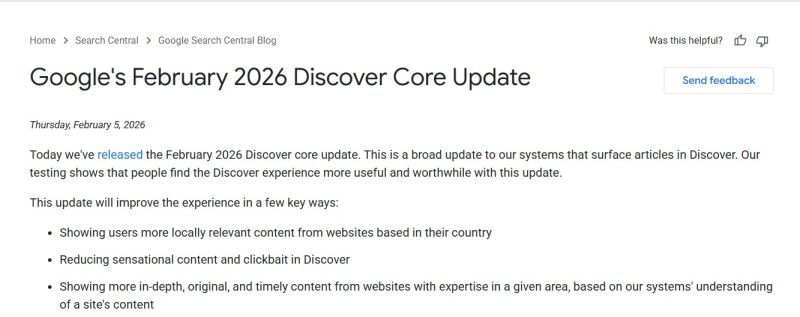
Most commentary framed this update as another quality refresh. That is surface-level thinking.
From what I have observed across client properties in the UK, traffic shifts were not random. The pattern was consistent:
- Sites with aggressive editorial calendars but weak authorship signals declined.
- Founder-led brands with clear expertise maintained or gained Discover exposure.
- Generic “thought leadership” pieces stopped appearing altogether.
Discover is predictive. It does not wait for search queries. It anticipates what a user may care about.
That means Google cannot rely purely on keywords. It must rely on entities, behaviour data, and trust signals tied to real people.
This update strengthened that evaluation layer.

How AI Search Engines Interpret Authority
AI search systems do not interpret authority the way marketers describe it.
Authority is not backlinks alone. It is not domain age. It is not content frequency.
AI models analyse patterns:
- Consistency of expertise across topics
- Coherence of author identity
- Cross-platform validation
- Historical engagement behaviour
- External references from trusted entities
Google has been explicit about Experience, Expertise, Authoritativeness, and Trust in its Search Quality Evaluator Guidelines. What changed in 2026 is enforcement through AI summarisation layers and Discover feeds.
When AI Overviews generate summaries, they compress the web into citations. Only entities that meet a threshold of reliability are referenced.
If your content reads like it could belong to anyone, AI systems treat it that way.
Interchangeable equals invisible.
Why Traditional SEO Content Is Losing Impact
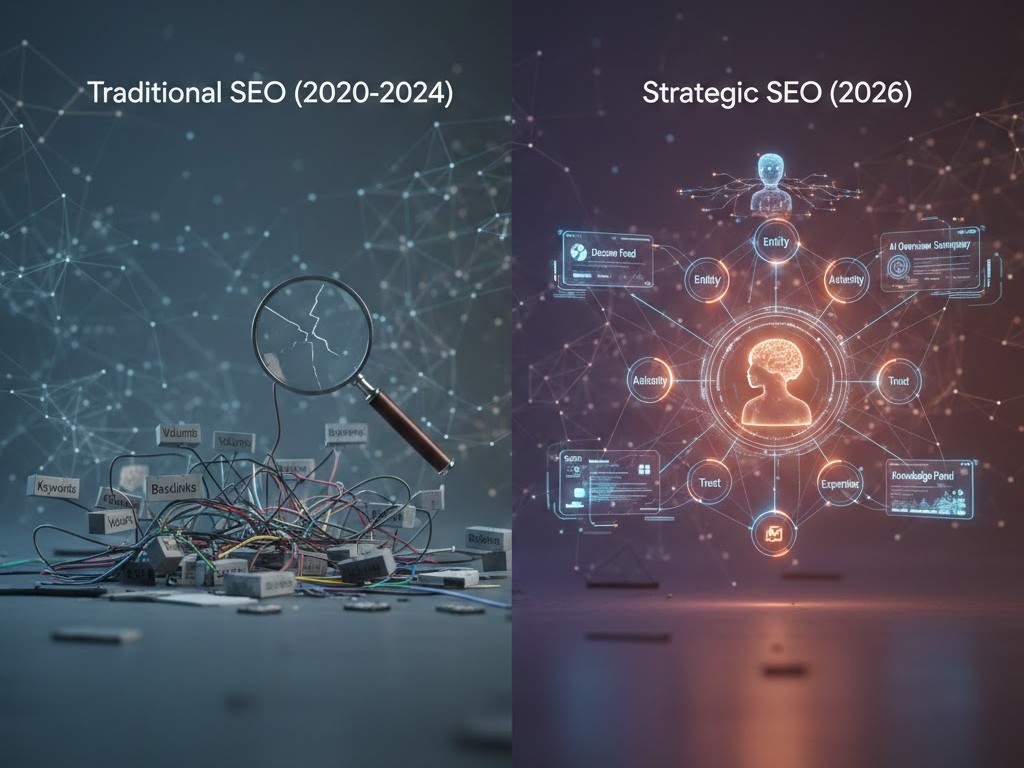
I have reviewed dozens of content strategies built between 2020 and 2024.
Most relied on:
- Topic clusters
- Keyword expansion tools
- Skyscraper-style expansion
- Template-based optimisation
Those tactics once worked because ranking was largely retrieval-based. Today, interpretation dominates retrieval.
When a page is created to target a phrase rather than express expertise, it shows.
AI systems evaluate semantic depth. They detect repetition. They detect paraphrasing.
Content that was designed to “cover a topic” without contributing original insight now underperforms in Discover and AI Overviews.
The issue is not optimisation. The issue is intention.
No Authority = No Visibility
You can publish 200 articles.
If none of them reinforce a recognisable expert identity, your Discover visibility will flatten.
Authority compounds. Content does not.
This is the shift founders need to internalise.
Google Discover does not care how much you wrote this month. It cares whether you are a reliable source on a subject over time.
When I audit declining sites, I often see:
- Multiple ghostwritten tones
- No consistent author positioning
- No first-hand examples
- No decision-making perspective
AI models struggle to map that to a trusted entity.
The result is quiet demotion, not penalty.
The Shift From Rankings to Visibility
Ranking reports are increasingly misleading.
A page can rank top three and still lose traffic because:
- AI Overviews answer the question directly
- Discover replaces search entry points
- Knowledge panels intercept branded intent
Visibility now spans multiple surfaces:
- Organic search
- AI summaries
- Discover feed
- Related entities
- Video surfaces
The question I ask clients has changed.
Not “Where do you rank?”
But “Where do you appear?”
Visibility is multidimensional. Rankings are singular.
Strategic SEO in 2026 means optimising for entity presence, not just page positions.
Content Depth Versus Content Volume
Depth is misunderstood.
Depth does not mean word count. It means:
- Real-world context
- Clear point of view
- Evidence from practice
- Nuanced trade-offs
I have seen 900-word articles outperform 3,000-word guides because they carried conviction and insight.
Volume strategies often create surface-level expansion. AI systems compress that surface-level similarity into irrelevance.
When ten sites publish near-identical commentary on an update, Discover filters most of them out.
Original analysis is not optional anymore.
It is the entry requirement.
Personal Brand Versus Company Brand in AI Results
This is where I have seen the clearest advantage.
AI systems prefer attributable expertise.
A company blog without a visible expert behind it struggles to earn Discover prominence.
A personal brand that consistently publishes high-signal analysis performs differently.
Why?
Because AI can map:
- Identity
- Historical expertise
- Cross-platform validation
- Named references
In the UK market especially, I have seen founders outperform established agencies in Discover exposure simply because their voice is coherent and recognisable.
Entity clarity wins.
That does not mean company brands cannot compete. It means they must humanise authority.
Anonymous publishing is fading.
Trust, Experience, and Real-World Proof
Experience is no longer implied. It must be demonstrated.
When I write or advise, I reference:
- Decisions made
- Mistakes corrected
- Patterns observed across industries
That signal matters.
Google’s own documentation on helpful content emphasises people-first expertise. Industry research from publications like Search Engine Journal consistently shows that first-hand insight correlates with sustained visibility.
But most content still avoids specifics because specifics require experience.
Generic writing feels safe. It is also forgettable.
Trust is built through detail.
For example:
Instead of saying “AI is changing SEO,” explain what shifted in a client’s traffic source mix after an update.
Instead of saying “authority matters,” show how entity consolidation improved Discover inclusion.
Precision builds credibility.
How Decision-Makers Actually Evaluate Expertise Today
Founders and agency owners do not evaluate expertise based on rankings alone.
They look for:
- Clear thinking
- Strategic framing
- Predictive accuracy
- Pattern recognition
When a strategist consistently anticipates shifts, that credibility compounds.
In my own advisory conversations, the turning point rarely comes from data alone. It comes from interpretation.
Anyone can report that traffic dropped after February 2026.
Fewer can explain why certain site types declined while others gained.
Decision-makers pay for interpretation.
AI systems reward it too.
What Most People Are Still Doing Wrong
Most people are still getting this wrong. They’re reacting tactically instead of thinking strategically. They publish reactive summaries, chase keywords that AI now answers directly, and optimise for density instead of clarity. The effort looks productive, but the outcomes keep shrinking.
Another mistake is separating brand from SEO. In 2026, those two are inseparable. If your brand positioning is weak, your SEO performance will reflect it. If your expertise is diluted, your visibility will shrink. Search systems no longer reward isolated pages. They reward credible entities.
Most advice online still focuses on “optimising pages.” Very little focuses on strengthening the entity behind those pages. And that gap is exactly where outcomes start to diverge.
FAQs
How has AI changed SEO and search visibility?
AI has shifted search from keyword retrieval to entity evaluation. Visibility now depends on recognised expertise, structured credibility, and cross-surface presence, not just rankings.
Is traditional SEO still worth investing in?
Yes, but only when integrated with authority building. Technical optimisation and keyword research still matter, yet they are foundational layers. They do not guarantee Discover or AI inclusion.
What makes content authoritative today?
Demonstrated experience, consistent identity, external validation, and clear perspective. Authority is earned through specificity and coherence over time.
How do personal brands perform in AI search?
Personal brands often perform strongly because AI systems can map expertise to a named entity. When identity and subject alignment are clear, Discover and AI summaries favour them.
What should businesses focus on in 2026?
Entity consolidation, experience-driven publishing, cross-platform credibility, and strategic positioning. Tactics without authority will not sustain visibility.
Conclusion
The Google February 2026 Discover Core Update reinforced a shift that has been building for years.
SEO is no longer about producing more content. It is about strengthening the entity behind the content.
Authority is interpreted algorithmically.
Trust is evaluated behaviourally.
Visibility is distributed across AI surfaces.
Those who understand this are adapting calmly.
Those who are still chasing volume are seeing quite declines.
If you want to think beyond rankings and build durable visibility in AI-driven search, explore the insights at Shehnoor Ahmed. I share strategy, not templates.
Read further.
Refine your positioning.
Or let us work together to build authority that compounds over time.
This post may contain affiliate links. As an affiliate partner, we may earn commissions from qualifying purchases made through these links, at no additional cost to you. Our recommendations are based on independent research and genuine opinions.