
Search no longer rewards presence. It rewards proof.
AI systems do not rank pages the way Google did ten years ago. They interpret credibility, experience, and consistency across sources. Visibility is now earned through authority signals that compound over time.
Most traditional SEO strategies are underperforming, not because SEO is dead, but because visibility mechanics have changed.
If you are still optimising for positions instead of perception, you are already behind.
How AI Search Engines Interpret Authority
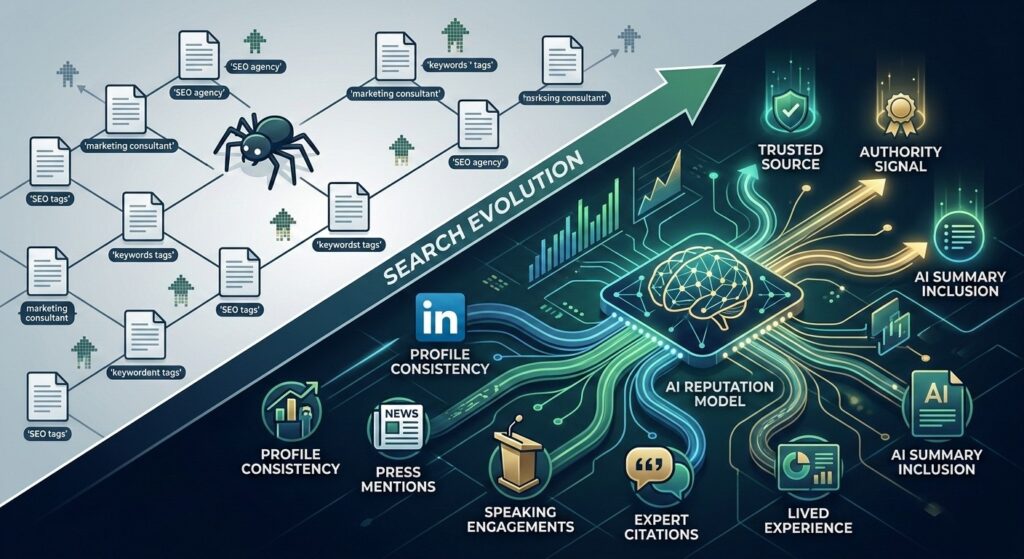
AI-driven search does not simply crawl and index. It models reputation.
Large language models synthesise information across websites, LinkedIn profiles, press mentions, interviews, and citations. They look for consistency in expertise, not isolated keyword wins.
Google’s own documentation on helpful, people-first content makes it clear that experience and originality are core signals. That language is not accidental. It reflects a structural shift.
From what I have observed across multiple UK service businesses, pages that “explain” a topic without demonstrating lived experience are increasingly ignored in AI summaries.
Authority now emerges from:
- Demonstrated depth across related topics
- Real-world case evidence
- Consistent positioning over time
- External validation signals
It is less about optimisation tricks and more about strategic coherence.
AI models are asking a simple question:
Is this source reliably knowledgeable?
Most websites cannot answer that convincingly.
If your visibility feels inconsistent despite ongoing SEO effort, it’s usually not a traffic problem. It’s an authority architecture problem.
Explore how I approach modern SEO and AI visibility strategy at Shehnoor Ahmed and see where your positioning may be misaligned.
Want to know why marketing services are more critical? Click here
Why Traditional SEO Content Is Losing Impact
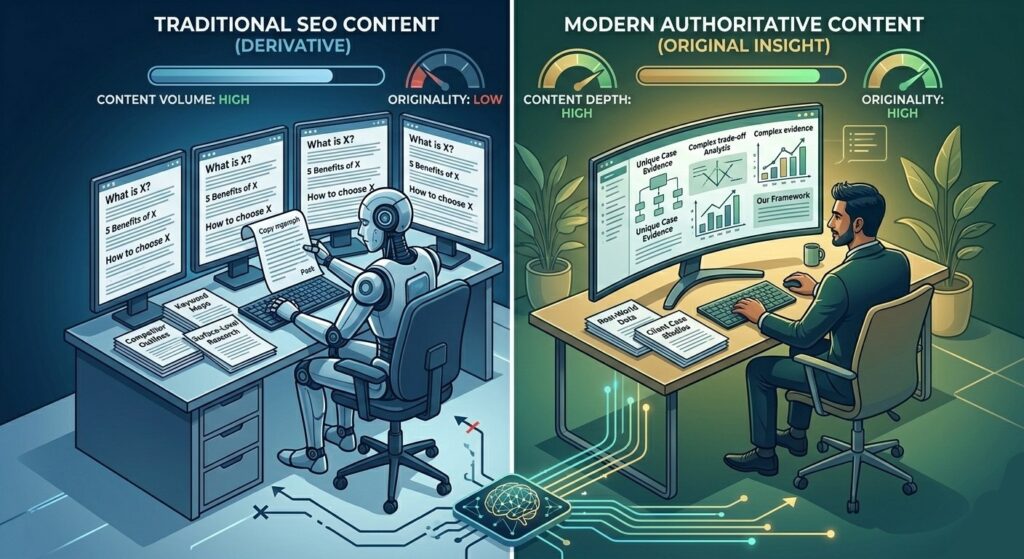
For years, content production meant:
- Identify keyword
- Analyse top 10 results
- Write a slightly longer article
- Add internal links
- Publish
That playbook worked when ranking was the primary goal.
Today, it produces noise.
I have audited sites publishing 20 blog posts per month and still declining in organic visibility. The issue was not technical SEO. It was content sameness.
AI filters repetition aggressively.
When every article follows the same structure, echoes the same phrases, and mirrors competitor outlines, models treat them as interchangeable. Interchangeable content does not earn visibility in AI summaries.
Research from publications like Search Engine Journal repeatedly shows volatility after core updates tied to quality signals. The pattern is consistent: derivative content loses ground.
Traditional SEO content fails because it:
- Optimises for keywords instead of insight
- Replicates surface-level information
- Avoids taking a point of view
- Lacks real examples
AI systems prioritise synthesis. If your content does not add anything new to that synthesis, it disappears.
Rankings ≠ Visibility
This is where many founders get misled.
You can rank and still be invisible.
AI Overviews, featured snippets, and LLM-generated responses extract information selectively. They may cite you. They may not. They may summarise your competitor instead.
Visibility now includes:
- Inclusion in AI-generated answers
- Being referenced in synthesis responses
- Brand mentions in authoritative contexts
- Recognition across multiple touchpoints
I have seen businesses holding position three for high-intent terms but receiving fewer qualified leads because AI summaries resolved the query without clicks.
The metric that matters is not ranking position. It is an influence within the answer layer.
That requires authority beyond a single page.
No Authority = No Visibility

You cannot optimise your way into trust.
Authority is cumulative. It builds through alignment between:
- Published insights
- Public positioning
- Experience proof
- Third-party validation
When those elements align, visibility follows.
When they conflict, AI systems hesitate.
One agency I advised had strong technical SEO. However, their blog targeted every marketing trend imaginable. There was no thematic ownership. AI systems could not categorise them as experts in anything specific.
After narrowing their content architecture to one strategic pillar and publishing depth over breadth, their inclusion in AI summaries improved within months.
Clarity created recognition.
Recognition created visibility.
Content Depth vs Content Volume
Content volume once signalled freshness. Today, it often signals insecurity.
Depth does not mean longer articles. It means layered understanding.
Depth looks like:
- Explaining trade-offs, not just tactics
- Showing the consequences of decisions
- Referencing observed patterns
- Connecting disciplines
Volume looks like publishing to stay active.
I regularly see founders outsource 50 articles per quarter. The traffic spike is temporary. The authority gain is negligible.
In contrast, a consultant publishing one original insight per month, consistently, builds a recognisable voice. AI models learn that voice.
This mirrors findings from independent SEO studies analysing content performance after Google’s Helpful Content updates. Originality correlates with resilience.
Depth compounds.
Volume exhausts.
Personal Brand vs Company Brand in AI Results
This is where the shift becomes uncomfortable for some organisations.
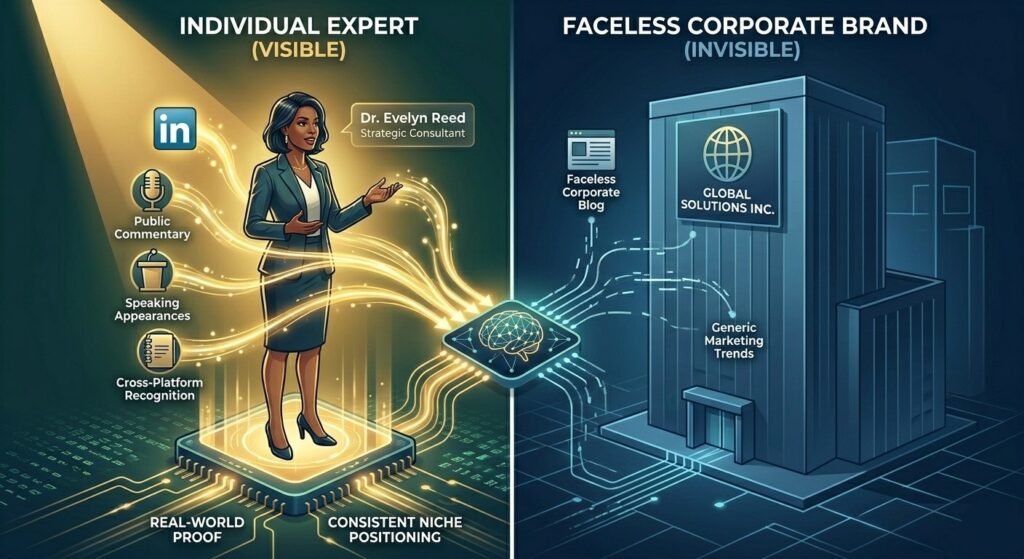
AI systems attribute expertise to people more easily than to abstract brands.
A named expert with:
- A clear point of view
- Public commentary
- Speaking appearances
- LinkedIn consistency
- Cross-platform recognition
will often surface in AI-driven answers before a faceless corporate blog.
I have seen this repeatedly across UK consultancy markets.
When decision-makers search complex questions, AI results frequently cite individual practitioners rather than agencies. Why? Because authority is easier to model when attached to a human identity.
This does not mean company brands are obsolete.
It means companies without visible experts struggle to earn trust in AI summaries.
Personal credibility accelerates company visibility.
Trust, Experience, and Real-World Proof
EEAT is often misunderstood as a checklist.
It is not.
Experience is increasingly weighted in subtle ways.
Signals include:
- Case-driven explanations
- Language reflecting lived decisions
- Consistent niche positioning
- Referenced frameworks adapted through practice
Google’s guidance on experience and trust signals reinforces this direction. The search ecosystem is moving toward verifiable expertise.
In my work, the strongest-performing pages often include:
- Specific scenarios
- Real constraints
- Acknowledgement of trade-offs
- Clear recommendations
Not abstract advice.
Decision-makers detect authenticity quickly. So do AI models trained on patterns of credible writing.
How Decision-Makers Evaluate Expertise Today
Founders do not hire based on rankings.
They evaluate:
- Depth of thinking
- Consistency of message
- Alignment with their challenges
- Evidence of strategic maturity
I have had discovery calls where clients referenced an article I wrote six months prior. Not because it ranked first. Because it demonstrated a way of thinking.
Expertise today is assessed through coherence.
If your content:
- Contradicts itself
- Chases trends
- Avoids strong positions
- Sounds interchangeable
trust erodes.
Authority emerges when your insights form a recognisable intellectual system.
That is what AI models learn. That is what clients remember.
What Most Businesses Are Still Doing Wrong
They are treating SEO as a channel.
It is not a channel anymore. It is a visibility ecosystem.
Common missteps I see:
- Over-investing in keyword maps without strategic positioning
- Publishing content detached from real consulting experience
- Ignoring personal authority signals
- Measuring success only through traffic
Traffic without trust does not convert.
Strategic thinking changes the outcome.
When you align:
- Expertise
- Public narrative
- Search visibility
- AI inclusion
The results compound.
When you isolate them, growth stalls.
FAQs
How has AI changed SEO and search visibility?
AI has shifted search from ranking-based discovery to answer-based synthesis. Visibility now depends on authority patterns, entity recognition, and cross-source credibility rather than keyword optimisation alone.
Is traditional SEO still worth investing in?
Yes, but only as a foundation. Technical health, structure, and search intent alignment still matter. However, without authority signals and strategic positioning, traditional SEO produces diminishing returns.
What makes content authoritative today?
Original insight, lived experience, thematic consistency, and external validation. Content that demonstrates decision-making depth outperforms generic educational material.
How do personal brands perform in AI search?
Personal brands often surface more prominently in AI-generated answers because expertise is easier to attribute to individuals. Clear positioning and consistent public presence strengthen this effect.
What should businesses focus on in 2026?
Authority consolidation. Narrower positioning. Depth over volume. Strategic visibility across both search engines and AI synthesis systems.
Conclusion
Digital marketing consulting has shifted from optimisation mechanics to authority architecture. Search engines are evolving into evaluators of credibility. AI systems synthesise, filter, and prioritise based on trust signals. Surface-level strategies no longer sustain visibility.
The advantage now belongs to those who think long term.
Build authority deliberately. Publish from experience. Align personal credibility with company positioning. Prioritise recognition over raw rankings.
That is the difference between temporary traffic and durable visibility. If you want to explore how modern SEO and AI search visibility intersect, Shehnoor Ahmed’s work focuses precisely on that intersection.
You can read further insights, examine strategic frameworks, or explore working together through shehnoorahmed.com.
The landscape has changed.
Strategic authority is now the asset that compounds.
This post may contain affiliate links. As an affiliate partner, we may earn commissions from qualifying purchases made through these links, at no additional cost to you. Our recommendations are based on independent research and genuine opinions.